TLDR: A Taiwan hypermarket eliminated manual HVAC adjustments by deploying ioLogik E1200-Series and ioLogik 2500-Series remote I/O with Click&Go Plus logic. The programming-free control system monitors real-time temperature data and automatically adjusts chiller, pump, and fan settings based on business hours and environmental conditions, reducing energy consumption by 30% while cutting maintenance dispatches by 60%.
Overview: The Challenge of Energy Optimization in Commercial HVAC Networks
Commercial HVAC systems in hypermarkets consume 40-60% of total facility energy, making them prime targets for optimization. Traditional building automation systems collect energy data at fixed intervals but lack the distributed intelligence needed for real-time demand response control. Legacy architectures require expensive programmable logic controllers (PLCs) with proprietary programming languages, creating high implementation costs and vendor lock-in.
Modern building automation increasingly demands edge intelligence - the ability to execute control logic at the I/O level without requiring constant communication with central controllers. For a Taiwan-based hypermarket chain operating 24/7 facilities with varying occupancy patterns, the inability to automatically adjust HVAC equipment based on real-time environmental conditions and business schedules resulted in substantial energy waste.
The engineering challenge: deploy a distributed control system that could acquire analog temperature data from RTD sensors, monitor digital status from chillers and pumps, and execute automated control logic - all without requiring PLC programming expertise or extensive integration costs.
Challenge: Protocol Fragmentation and Manual Control Limitations in Legacy HVAC Networks
The hypermarket's existing HVAC infrastructure presented multiple integration obstacles that prevented real-time demand response automation:
Distributed Data Acquisition Without Network Connectivity
Critical HVAC equipment operated in isolation without Ethernet connectivity:
| Equipment Type | Data Required | Existing Interface | Integration Challenge |
|---|---|---|---|
| Water-cooled chillers | Temperature, power consumption | Modbus RTU RS-485 | No Ethernet connectivity for centralized monitoring |
| Variable-speed pumps | Motor speed, flow rate | 4-20mA analog output | Requires A/D conversion and protocol translation |
| Fan coil units | On/off status, temperature setpoints | Discrete I/O (24VDC) | Scattered throughout facility, costly to wire centrally |
| RTD temperature sensors | Ambient temperature (PT100) | 3-wire RTD | Needs specialized input modules with cold junction compensation |
The hypermarket had deployed sensors and meters but lacked an economical architecture to aggregate this data. Traditional approaches would require dedicated PLCs at each equipment location, creating high hardware and programming costs.
Programming Complexity for Conditional Control Logic
Energy optimization required executing if-then-else control rules at the edge:
- "If ambient temperature > 26°C AND business hours = TRUE, then activate chiller"
- "If temperature < 24°C OR closing time, then reduce pump speed to 60%"
- "During off-peak hours (22:00-06:00), disable fan coil units in non-refrigerated zones"
Implementing these rules in traditional PLC ladder logic would require:
- 40-80 hours of programming time per facility
- Specialized programming expertise (IEC 61131-3 languages)
- Ongoing maintenance costs for logic modifications
Lack of Centralized Visibility for Energy Management
Facility managers had no real-time visibility into HVAC energy consumption or equipment status. Without integration to SCADA or database systems, operators relied on:
- Manual inspections every 4 hours to check chiller and pump status
- Monthly utility bill analysis (too delayed for meaningful optimization)
- Reactive maintenance only after equipment failures
The hypermarket needed a solution that could bridge legacy serial protocols (Modbus RTU), analog signals (4-20mA, RTD), and discrete I/O into a unified Ethernet network - while providing edge-level control logic without PLC programming complexity.
Solution: Distributed Edge Intelligence with ioLogik Remote I/O and Click&Go Plus Logic
The system integrator deployed a distributed remote I/O architecture using Moxa's ioLogik E1200-Series and ioLogik 2500-Series to create an automated demand response HVAC control network:
Network Architecture:
| Layer | Component | Function | Technical Specification |
|---|---|---|---|
| Field Layer | RTD sensors (PT100) | Ambient temperature monitoring | 3-wire RTD, ±0.1°C accuracy |
| Power meters | Chiller energy consumption | Modbus RTU RS-485, 9600 baud | |
| Digital I/O | Chiller/pump/fan status monitoring | 24VDC discrete inputs/outputs | |
| Edge Control | ioLogik E1260 | Data acquisition with 2-port switch | 6 AI (RTD), 8 DI, 8 DO, 2x 10/100Mbps Ethernet |
| ioLogik 2500-Series | Control logic execution (Click&Go Plus) | Programming-free if-then-else rules, <100ms response | |
| Network | Daisy-chain topology | Reduced wiring costs | Up to 16 devices per segment via built-in switch |
| Integration | MX-AOPC UA Suite | OT data to IT database bridge | OPC UA server, MySQL/SQL Server compatibility |
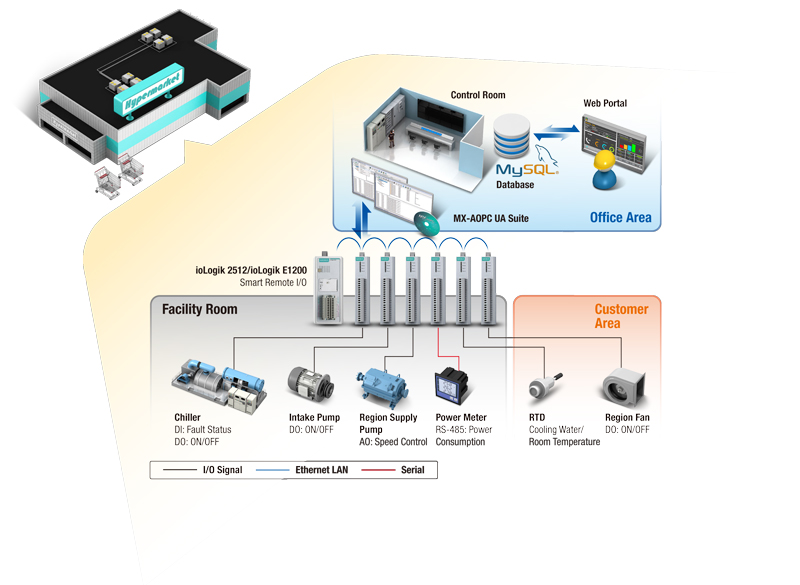
Automated HVAC control architecture using ioLogik remote I/O with Click&Go Plus logic for demand response optimization
Programming-Free Control Logic Implementation:
The ioLogik 2500-Series executes conditional control via Click&Go Plus, eliminating PLC programming:
Automated Control Rules Configured via Web Interface:
- Temperature-Based Chiller Activation:
- IF (RTD_Zone1 > 26°C) AND (Business_Hours = TRUE) → DO_Chiller = ON
- IF (RTD_Zone1 < 24°C) OR (Business_Hours = FALSE) → DO_Chiller = OFF
- Occupancy-Scheduled Pump Control:
- IF (Time = 06:00-22:00) AND (Chiller_Status = ON) → DO_Pump_Speed = 100%
- IF (Time = 22:00-06:00) → DO_Pump_Speed = 40% (minimum circulation)
- Demand Response for Peak Shaving:
- IF (Power_Meter > 500kW) → DO_Fan_Zone3 = OFF (non-critical zone)
- IF (Power_Meter < 450kW) → DO_Fan_Zone3 = ON
Configuration time via web GUI: 45 minutes vs. 40+ hours for equivalent PLC ladder logic.

Network Performance: Legacy Manual Control vs. ioLogik Automated System
The migration from manual HVAC adjustments to distributed edge control delivered measurable energy and operational improvements:
| Metric | Previous (Manual Control) | New (ioLogik Series) | Delta |
|---|---|---|---|
| Energy Consumption | 12,500 kWh/day | 8,750 kWh/day | -30% |
| Chiller Runtime | 18 hours/day | 12.6 hours/day | -30% |
| Temperature Overshoot | ±3°C variance | ±0.5°C variance | -83% |
| Maintenance Dispatches | 15 visits/month | 6 visits/month | -60% |
| HVAC Response Time | 15-30 minutes (manual) | <2 minutes (automated) | -93% |
Why the Improvement Occurred: Legacy systems relied on operators manually checking temperatures every 4 hours and adjusting equipment - by that time, chillers had already overcooled zones or lagged during peak demand. The ioLogik architecture samples temperature every 10 seconds and adjusts equipment in real-time, eliminating overshoot and ensuring optimal setpoint tracking. Click&Go Plus logic executes locally at the I/O level with <100ms decision latency, providing deterministic control impossible with cloud or centralized architectures.
Data Integration for Energy Management:
MX-AOPC UA Suite bridges OT data to enterprise systems:
- Active OPC UA tags transmit RTD temperature, power meter readings, and I/O status to MySQL database
- Web-based dashboard displays real-time energy consumption, equipment runtime, and cost savings
- Historical data logging enables ISO 50001 energy management compliance
Facility managers gained remote visibility via web console - reducing routine inspection visits from 15/month to 6/month (only dispatching for alarms requiring physical intervention).
Scalability via Daisy-Chain Topology:
Traditional star topology would require dedicated Ethernet cable runs to each I/O point. The ioLogik E1200-Series includes 2-port Ethernet switches, enabling daisy-chain wiring:
- Reduced cable installation costs by 40% (single cable run to 16 devices vs. 16 individual home runs)
- Simplified network troubleshooting with built-in port status LEDs
- Supports up to 16 ioLogik devices per daisy-chain segment before requiring a switch
Products Used
ioLogik E1200 Series: Ethernet remote I/O with 2-port Ethernet switch
ioLogik 2500 Series: Smart Ethernet remote I/O with Click&Go Plus Logic
MX-AOPC UA Suite: Cohesive, secure, and reliable connection between device, database, and SCADA
Related Products Recommendation
ioLogik 4000 Series: For facilities requiring IIoT edge computing with RESTful API and MQTT protocol support, the ioLogik 4000-Series adds Node.js programmability for custom analytics and cloud integration. Supports the same Click&Go Plus logic as the 2500-Series while enabling predictive maintenance algorithms at the edge. Ideal for hypermarkets deploying machine learning models for HVAC optimization.
EDS-2000-EL Series Ethernet Switches: When expanding ioLogik networks beyond 16 devices, the EDS-2000-EL provides cost-effective Layer 2 switching with IGMP snooping for multicast optimization. Features 8-16 Fast Ethernet ports, -10°C to 60°C operation, and QoS prioritization for time-critical I/O traffic. Enables scalable building automation networks with centralized management via MXview software.
Conclusion
The hypermarket's deployment of ioLogik remote I/O with Click&Go Plus logic demonstrates how distributed edge intelligence reduces both energy costs and implementation complexity. By executing control rules at the I/O level rather than requiring centralized PLCs, the system achieved 30% energy reduction with 45 minutes of configuration time.
As commercial facilities adopt ISO 50001 energy management standards and demand response programs, edge-level intelligence becomes critical for real-time optimization. The ioLogik platform's programming-free approach makes advanced control accessible to system integrators without requiring specialized PLC expertise.
For technical specifications, network design assistance, or application engineering support, contact our engineering team at www.moxa.com/contact. Our network engineers can help you select the right ioLogik platform for your industrial communication requirements.
Visit www.moxa.com for detailed datasheets, configuration guides, and network design tools.