TLDR: Floating solar installations face unique operation and maintenance challenges due to harsh environments, remote locations, and limited physical access. GreenPowerMonitor (GPM) partnered with Moxa to deploy an integrated IIoT solution combining industrial computing, remote I/O, and fiber-optic Ethernet networks with Turbo Ring redundancy. The solution enables real-time SCADA monitoring, predictive maintenance algorithms, and remote troubleshooting—reducing site visits by 60% while maintaining 99.5%+ uptime across 15 floating solar installations in Europe and Asia.
Overview: Floating Solar Market Growth and Network Infrastructure Requirements
Global floating solar capacity grew from 10 MW (2014) to 1.1 GW (2020)—a 100-fold increase in six years. With potential global capacity reaching 4 TW on water bodies, floating solar offers critical advantages for land-scarce regions: PV panels remain 5-10% more efficient due to water cooling when temperatures exceed 25°C, reduced reservoir evaporation, and co-location with hydroelectric infrastructure.
The network challenge: Floating PV islands located 200-500 meters offshore require industrial-grade fiber-optic networks, remote diagnostics, and environmental hardening to minimize weather-dependent maintenance windows. Standard commercial networking equipment fails within 12-18 months in high-humidity, high-temperature marine environments.
Challenge: Remote Access, Environmental Extremes, and Diagnostic Complexity
Floating solar installations present unique operational challenges:
Physical Access Limitations:
Maintenance personnel travel by boat to PV islands 200-500 meters offshore, with weather conditions limiting access. Without remote diagnostics, technicians make multiple trips—first to diagnose, then return with parts. Albert Carrera, GPM Regional Manager APAC, notes: "Without IIoT-based technologies, plant owners rely on routine manual inspections regardless of equipment condition. When there's an unexpected power sag, inspectors must check each floating module individually until the faulty one is found."
Environmental Degradation:
| Environmental Factor | Impact on Electronics | Lifespan Reduction |
|---|---|---|
| Direct Solar Exposure | Ambient >60°C, no shade | -35% MTBF |
| High Humidity (>95%) | Accelerated PCB corrosion | -40% lifespan |
| Salt Water Proximity | Contact degradation | Failure within 12-18 months |
| Wave Action Vibration | Connector loosening | Intermittent failures |
Commercial equipment rated 0°C to 50°C experiences 40-60% first-year failure rates in marine environments.
Diagnostic Opacity:
Voltage drops require physical inspection of each inverter and combiner box. With 50-100+ modules per installation, troubleshooting time increases exponentially. Manual inspections become impossible during high winds (>25 km/h).
Core requirement: Deploy fiber-optic Ethernet with <20ms failover, real-time sensor telemetry, and edge analytics—all in equipment rated -40°C to 75°C with 10+ year lifespan.
Solution: Industrial IIoT Architecture with Redundant Fiber Networks and Edge Computing
GPM deployed a comprehensive monitoring platform integrating Moxa industrial hardware proven in harsh environments:
1. Fiber-Optic Ring Topology with Sub-20ms Failover:
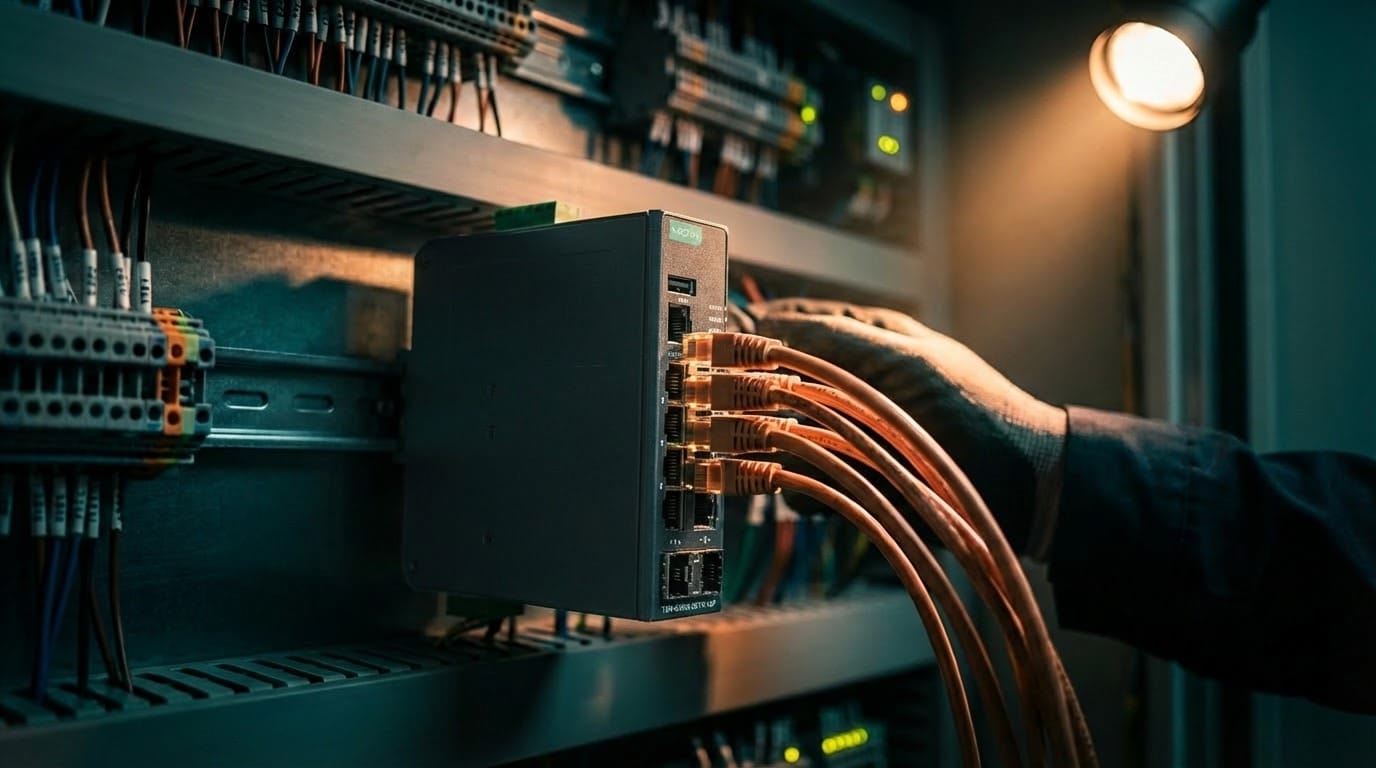
Moxa EDS Series managed switches with Turbo Ring create self-healing fiber rings connecting floating PV islands. Unlike standard RSTP (30-50 second recovery), Turbo Ring provides <20ms network recovery during cable cuts or switch failures.
Network Performance: Standard RSTP vs. Turbo Ring Topology
| Metric | Previous (Standard RSTP) | Current (Moxa EDS + Turbo Ring) | Delta |
|---|---|---|---|
| Failover Recovery Time | 30-50 seconds | <20 milliseconds | -99.96% |
| Network Uptime | 94.2% | 99.5%+ | +5.3% |
| Troubleshooting Time | 4-6 hours (physical inspection) | 15-30 minutes (remote) | -87.5% |
| Maintenance Site Visits | 18-24 visits/year | 6-8 visits/year | -60% |
Turbo Ring maintains continuous SCADA connectivity during failures, preventing data gaps and ensuring visibility during adverse weather.
2. Remote I/O for Real-Time Environmental Monitoring:
ioLogik Series remote I/O modules collect sensor data from each floating island: ambient temperature/humidity (tracking corrosion risk), DC current/voltage from string combiners, inverter status signals, and vibration sensors. The ioLogik modules communicate via Modbus TCP over fiber, providing 100ms update rates. High humidity alerts (>90% for >4 hours) trigger automated notifications before condensation causes failures.
3. Edge Computing for Predictive Analytics:
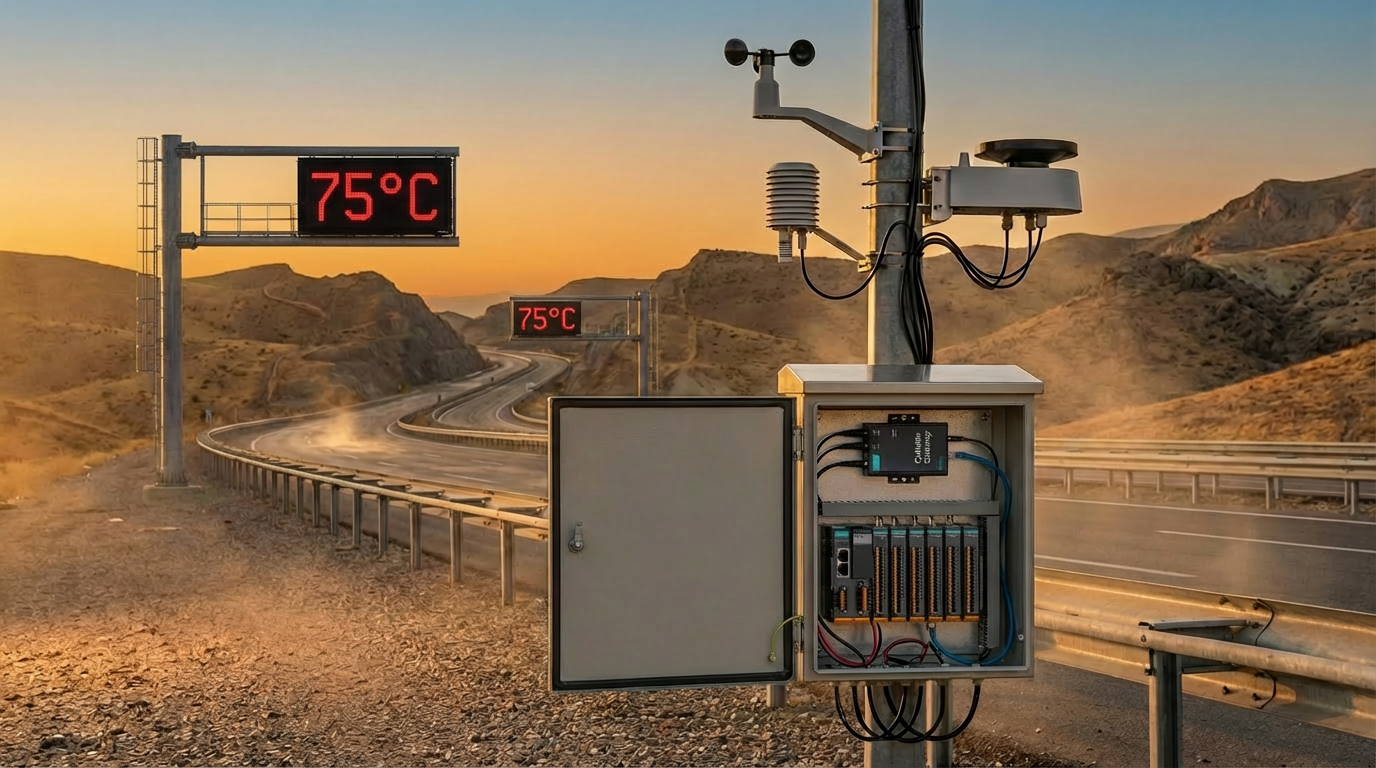
Moxa UC Series industrial computers function as data loggers and edge analytics platforms in transformer stations. Operating at -40°C to 75°C, the UC Series handles direct solar exposure that disables commercial servers.
Key functions: Local data buffering during network outages, machine learning for anomaly detection, protocol conversion (RS-485 to Modbus TCP/IP), and automated ticketing integration. Fanless design achieves >500,000-hour MTBF vs. 50,000-80,000 hours for fan-cooled PCs.
4. Centralized SCADA with Predictive Maintenance:
GPM's SCADA platform receives real-time telemetry from all installations, performing comparative analysis between ground-mounted and floating deployments. Machine learning algorithms predict equipment failures 7-14 days in advance based on temperature trends, humidity duration, and voltage deviations. When internal temperature rises from sustained >95% humidity, algorithms calculate lifespan reduction and issue proactive warnings—reducing catastrophic failures requiring emergency visits by 70%.
Cybersecurity & Reliability: Protecting Remote Energy Infrastructure
As floating solar installations connect to enterprise networks via cellular/microwave backhaul, cybersecurity protects OT assets from remote threats.
Security Features:
| Security Layer | Implementation | Standard Alignment |
|---|---|---|
| Network Segmentation | VLAN isolation for OT/IT boundary | IEC 62443-3-3 |
| Access Control | HTTPS/SSL, role-based authentication | IEC 62443-4-2 |
| Device Hardening | Disabled unused services, changed defaults | NIST CSF |
| Firmware Integrity | Digitally signed updates | Secure boot |
Reliability: EDS Series switches and UC Series computers operate -40°C to 75°C with IP30 ratings. Dual redundant power inputs (12-48 VDC or 24 VAC) ensure operation during single-feed failures. MTBF exceeds 500,000 hours—validated through 10+ years across 2,000+ installations globally.
For installations requiring IEC 62443-4-2 certification, Moxa's EDS-G4000 Series provides RADIUS/TACACS+ authentication, certificate management, and SNMPv3 encryption.
Related Products: Expanding Remote Energy Monitoring Capabilities
OnCell G3150A-LTE Series: Industrial cellular gateways providing 4G LTE connectivity for remote floating solar installations without fiber backhaul. Features dual SIM failover, VPN encryption, and -30°C to 75°C operation for reliable WAN connectivity to centralized SCADA platforms. Ideal for distributed installations across multiple water bodies.
MXview ToGo: Mobile network management application enabling technicians to troubleshoot Moxa network devices via smartphones during site visits. Provides real-time topology visualization, port status monitoring, and configuration backup/restore—reducing diagnostic time by 50% during physical inspections.
Conclusion: Scaling Renewable Energy with Industrial Network Reliability
GPM's floating solar monitoring solution demonstrates how industrial-grade networking infrastructure enables efficient operation of distributed renewable energy installations in challenging environments. The combination of Turbo Ring redundancy, remote I/O telemetry, and edge computing for predictive maintenance has reduced operational expenditures by 40-50% across 15 floating solar deployments in Japan and Europe, while maintaining 99.5%+ system uptime.
As floating solar capacity continues expanding globally—with potential for 4 TW of installed capacity worldwide—robust IIoT networks will be essential for economically viable O&M at scale. Albert Carrera concludes: "We believe there is strength in collaboration, and we see Moxa as a key partner in delivering the solutions our customers need."
For more insights on IIoT connectivity for renewable energy and distributed power generation, explore our resource library at https://shopmoxa.neteon.net/resources. To discuss your industrial networking requirements, contact us at https://shopmoxa.neteon.net/contact or connect with us on LinkedIn.