
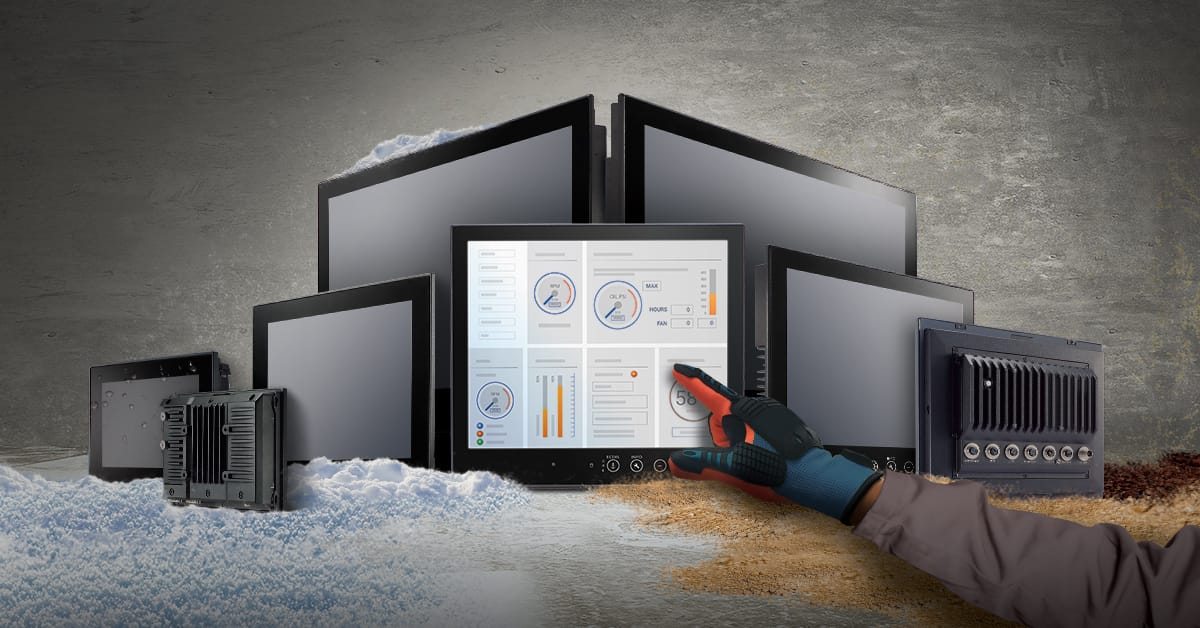
MPC-3000 Series (newest, launched late 2024) — This is where the buzz is. Six models ranging from 7" to 15.6", powered by Intel Atom x6000E processors (x6211E dual-core or x6425E quad-core). Key specs that are turning heads: -30°C to 60°C operating range, fanless/heaterless design, IP66-rated enclosures, 400 or 1000-nit sunlight-readable displays, glove-friendly multi-touch, and a cableless modular architecture for both front and rear panels. Certified for C1D2, ATEX Zone 2, IECEx Zone 2, DNV, IEC 60945, and IACS E10.
EXPC-F Series (higher-performance, hazardous locations) — The EXPC-F2120W (12.1") and EXPC-F2150W (15.6") step up to Intel Tiger Lake processors (Celeron 6305E through Core i7-1185G7E), 16GB RAM, 1200-nit displays, -40°C to 70°C range, and Zone 2/22 hazardous area certification. These are on ShopMoxa with AC and DC power input variants.
MPC-2000 Series (legacy/specialized) — Older Atom E3800-based models including railway-certified units (MPC-2101 with EN 50155) and marine units (MPC-2260 with NMEA 0183). Still actively sold for specific verticals.

Why the Popularity Surge
A few converging factors are driving the interest:
The global industrial panel PC market is projected to grow from $1.11 billion in 2024 to $1.54 billion by 2032 at a 4.2% CAGR, with Asia-Pacific leading the demand. Moxa timed the MPC-3000 launch to ride this wave directly.
The modular cableless design is the real differentiator generating attention. Moxa minimized system complexity by employing a cableless design for both front and rear panels, enabling quick component replacement. In practice, this means field technicians can swap components without specialized skills, reducing mean time to repair significantly — a big deal for offshore oil rigs and remote marine installations where getting a technician on-site costs thousands per hour.
The breadth of hazardous certifications in a single product line is another driver. Having C1D2 + ATEX Zone 2 + IECEx + DNV + IEC 60945 + IACS across the same family means engineers can standardize on one platform for oil & gas, marine, and general industrial applications instead of qualifying three different vendors.
The no-fan, no-heater approach for -30°C to 60°C operation also eliminates the two most common mechanical failure points in industrial PCs, which directly impacts lifecycle cost.
Competitive Comparison
Here's how Moxa stacks up against the main players:
| Factor | Moxa MPC-3000 | Advantech TPC/PPC | Siemens SIMATIC IPC | Beckhoff CP Series |
|---|---|---|---|---|
| Core Strength | Hazardous/marine certifications, networking integration | Broadest portfolio, vertical customization | PLC/SCADA ecosystem lock-in | PC-based control (PLC+HMI unified) |
| Processor Range | Atom x6000E (entry-mid) | Atom through Core i7 (full range) | Atom through Core i (full range) | Atom through Core i (full range) |
| Display Sizes | 7"–15.6" | 10.4"–24" | 7"–22" | 7"–24" |
| Max Brightness | 1000 nits | 500–1000 nits | 500–1000 nits | 500–1000 nits |
| Wide Temp Range | -30°C to 60°C | -20°C to 60°C (typical) | -20°C to 55°C (typical) | 0°C to 55°C (typical) |
| Hazardous Certs | C1D2, ATEX Z2, IECEx Z2 | Limited (model-dependent) | Limited (model-dependent) | Not standard |
| Marine Certs | DNV, IEC 60945, IACS E10 | DNV (select models) | DNV (select models) | Not standard |
| Modularity | Cableless front+rear | Modular expansion slots | Panel-mount focused | Modular with C-mount |
| Best For | Oil & gas, marine, outdoor | General factory automation, retail, logistics | Siemens-ecosystem factories | Machine builders, motion control |
| Weakness | Lower processing ceiling (Atom-only on MPC-3000) | Certification depth for hazardous | Premium pricing, ecosystem dependency | Limited hazardous/marine options |
Key takeaways for competitive positioning:
vs. Advantech: Advantech wins on breadth (more screen sizes, processor options, vertical-specific models) and is the default for general factory automation. But Moxa wins decisively in hazardous location and marine certification depth, plus the networking synergy — Moxa's industrial switches and routers can be managed alongside their panel PCs through a unified approach, which Advantech can't match as cleanly.
vs. Siemens: Siemens dominates when the customer is already running SIMATIC PLCs and WinCC SCADA because the integration is seamless. But Siemens panel PCs carry premium pricing and create vendor lock-in. Moxa's open architecture (supports various PLC/SCADA systems) is the counter-argument for customers who want flexibility.
vs. Beckhoff: Beckhoff is unbeatable for machine builders who want PLC + motion control + HMI on one device via TwinCAT. But they're weak outside the factory floor — no serious hazardous or marine certifications. Moxa owns the outdoor/hazardous/marine space where Beckhoff doesn't play.
The EXPC-F series closes the processing power gap against Advantech and Siemens by offering up to Core i7-1185G7E with 16GB RAM, 1200-nit displays, and -40°C to 70°C range — but at a higher price point.
The Neteon/ShopMoxa Angle
We carry both families on ShopMoxa — the MPC-3000 series and the full EXPC-F lineup. The MPC-3070W through MPC-3150W are all available with dual-core (E2) and quad-core (E4) processor options, and the EXPC-F2120W/F2150W range from Celeron through Core i7 with AC or DC power variants.