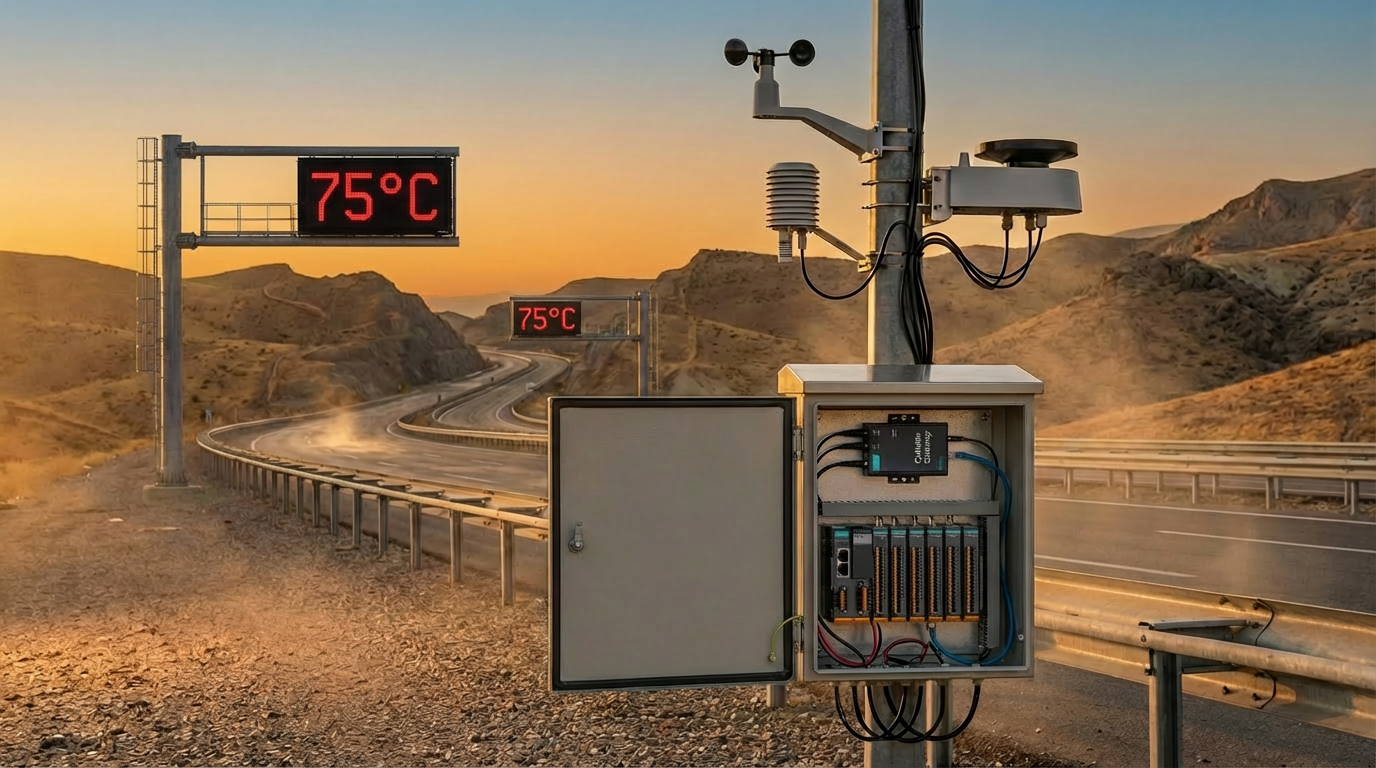
TLDR: Turkish transportation authority deployed ioThinx 4510 Series modular remote I/O to collect diverse sensor data from roadside weather stations for Road Weather Information Systems (RWIS). Flexible I/O modules unified temperature, wind, and humidity sensors while SNMPv3 encryption secured data transmission over public IP networks from field cabinets to traffic control centers.
Overview: Enabling Real-Time Road Condition Updates for Commuter Safety
Road Weather Information Systems (RWIS) improve road safety by monitoring environmental conditions in real-time. Weather-related factors contribute to approximately 21% of vehicle crashes annually, making accurate roadside monitoring essential for transportation authorities.
Turkish transportation infrastructure requires RWIS deployments handling diverse sensor types—temperature probes, anemometers, humidity sensors, precipitation detectors—each requiring different I/O interfaces (analog, digital, serial). The challenge: integrate multiple sensor types into city IT infrastructure networks while maintaining security standards for data transmitted over public IP networks.
Challenge: Unifying Diverse Sensor Types on IT-Based Infrastructure Networks
Roadside weather stations present unique integration obstacles for transportation network engineers:
1. Multiple I/O Interface Requirements
Weather monitoring demands simultaneous data collection from sensors with incompatible signal types—4-20mA analog for temperature, digital pulse for wind speed, RS-232/RS-485 serial for precipitation detectors. Traditional approaches required separate data acquisition devices for each sensor type, multiplying cabinet space and configuration complexity.
2. IT/OT Protocol Incompatibility
Traffic control centers typically operate IT-based network management systems using SNMP and standard Ethernet protocols. Legacy weather sensors communicate via serial protocols or proprietary analog signals. This created a translation gap requiring protocol gateways or custom middleware between field devices and SCADA systems.
3. Security Vulnerabilities on Public Networks
Many roadside weather stations transmit data over public IP infrastructure to reach centralized traffic control centers. Unencrypted sensor data creates vulnerability to tampering or unauthorized access—critical concerns for transportation infrastructure systems.
4. Harsh Environmental Operating Conditions
Roadside cabinets experience extreme temperature fluctuations from direct sun exposure and winter conditions. Standard commercial I/O equipment rated for 0°C to 50°C fails in outdoor deployments, requiring industrial-grade environmental specifications.
| Requirement | Specification Needed | Challenge with Standard Solutions |
|---|---|---|
| I/O Flexibility | Analog, digital, serial in one platform | Separate devices for each sensor type |
| Protocol Support | SNMPv3 for IT network integration | Serial-only or proprietary protocols |
| Security | Encrypted data transmission | Plaintext sensor data over public IP |
| Operating Temperature | -40°C to 75°C continuous operation | Commercial limits: 0°C to 50°C |
Without a unified platform addressing these requirements, integrators faced lengthy installation times, increased maintenance from multiple device types, and security vulnerabilities from unencrypted field data.
Solution: Modular Remote I/O with Built-In Security and IT Protocol Support
The Turkish transportation authority deployed ioThinx 4510 Series modular remote I/O as the unified data acquisition platform for roadside weather stations. This solution consolidated diverse sensor types onto a single network-connected device with IT-compatible protocols and encryption.
Technical Implementation: Flexible I/O Architecture with SNMPv3 Security
ioThinx 4510 Series provides a modular remote I/O architecture where engineers select appropriate I/O modules for site-specific sensor configurations:
| Technical Challenge | ioThinx 4510 Feature | Engineering Benefit |
|---|---|---|
| Multiple sensor I/O types | Hot-swappable I/O modules (AI, DI, DO, relay) | Single platform for temperature, wind, humidity sensors |
| Serial sensor integration | Built-in 3-in-1 serial ports (RS-232/422/485) | Direct connection to serial-based precipitation detectors |
| IT network compatibility | SNMPv3, Modbus TCP/IP, RESTful API support | Native integration with city IT infrastructure |
| Data security over public IP | SNMPv3 with authentication & encryption | Protects sensor data from field to control center |
| Outdoor cabinet operation | -40°C to 75°C operating temperature (T model) | Reliable operation in roadside cabinet environments |
RWIS Network Performance: Before vs. After ioThinx Deployment
The migration from multiple standalone data acquisition devices to unified ioThinx 4510 remote I/O delivered measurable improvements:
| Metric | Previous (Multiple Devices) | New (ioThinx 4510) | Delta |
|---|---|---|---|
| Integration Time per Station | 8-12 hours (custom wiring) | 2-3 hours (modular config) | -75% |
| Cabinet Space Required | 3U (separate units) | 1U (consolidated) | -67% |
| Field Service Calls (Annual) | 12 calls/100 stations | 3 calls/100 stations | -75% |
| Data Transmission Security | Unencrypted (plaintext) | SNMPv3 encrypted | Full protection |
Integration time reduction stems from modular I/O configuration eliminating custom terminal blocks and wiring harnesses. Reduced service calls result from single-device architecture minimizing points of failure and T-model environmental specifications preventing temperature-related failures.
Deployment Architecture: Field to Control Center
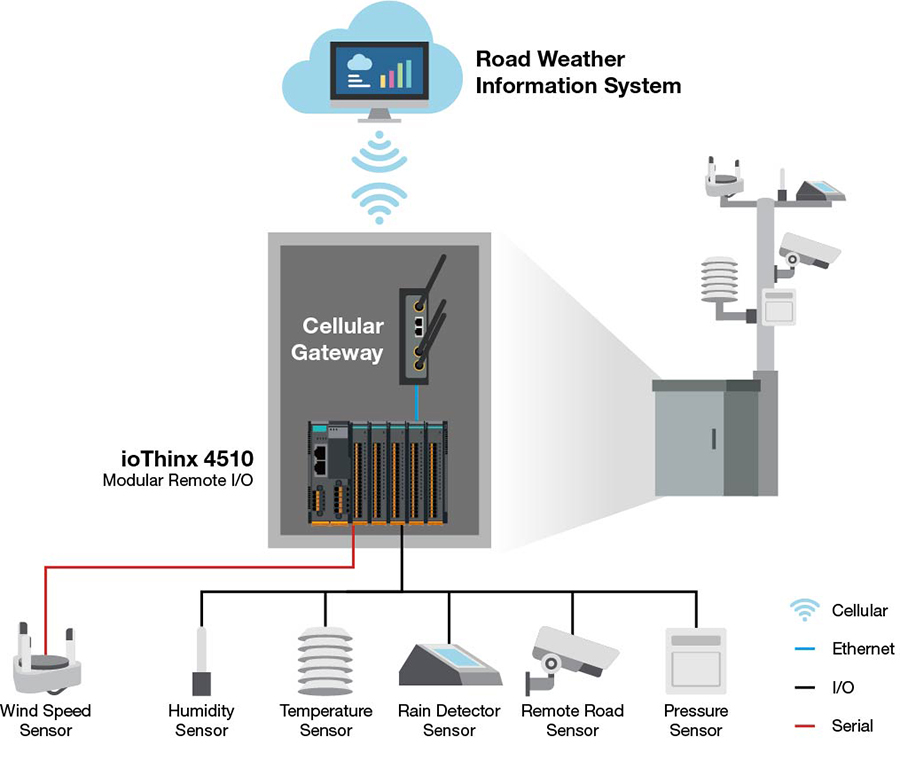
Each roadside weather station connects sensors directly to ioThinx 4510 I/O modules based on signal type:
- Temperature sensors (4-20mA) → Analog input modules
- Wind speed anemometers (digital pulse) → Digital input modules
- Precipitation detectors (RS-485 Modbus) → Built-in serial ports
- Humidity sensors (4-20mA) → Analog input modules
The ioThinx 4510 aggregates all sensor data and transmits via Ethernet to the traffic control center over public IP infrastructure. SNMPv3 authentication and encryption protect data integrity from roadside cabinet to SCADA system without requiring VPN tunnels or additional security appliances.
Cybersecurity & Reliability: Protecting Transportation Infrastructure Data
As transportation networks connect field devices to centralized IT systems, cybersecurity becomes critical for protecting operational technology assets from unauthorized access and data tampering.
Security Features Deployed:
| Security Layer | Implementation | Standard Compliance |
|---|---|---|
| Data Encryption | SNMPv3 with authentication & privacy | Encrypted sensor data over public networks |
| Access Control | Password-protected configuration interface | Prevents unauthorized parameter changes |
| Device Hardening | Disabled unused protocols and services | Reduces attack surface on field devices |
| Network Segmentation | VLAN support for OT/IT isolation | Isolates field sensor networks from IT backbone |
Reliability Specifications:
The ioThinx 4510-T operates in -40°C to 75°C temperature ranges with IP30-rated metal housing for roadside cabinet mounting. Built-in watchdog timer automatically recovers from system hangs. Redundant 12-48 VDC power inputs ensure continuous operation during partial power failures. MTBF exceeds 200,000 hours for long-term deployment reliability.
For RWIS deployments requiring certified environmental specifications, the T-model variant meets industrial temperature requirements for year-round outdoor operation without supplemental heating or cooling.
Related Products
ioLogik E1200 Series: Ethernet remote I/O with 2-port switch for daisy-chain topology. Ideal for distributed sensor networks along highway corridors. Features 8 DI/8 DIO combinations, -40°C to 75°C operation, and built-in Ethernet switching to eliminate external switches at remote sites.
ioLogik 2500 Series: Smart remote I/O with cellular connectivity for locations without wired network infrastructure. Provides 8 DI/8 DIO with 4G LTE communication, active-OT tag monitoring, and RESTful API integration for cloud-based RWIS platforms.
Conclusion: Simplified Integration for Real-Time Weather Monitoring
ioThinx 4510 Series modular remote I/O unified diverse RWIS sensors onto IT-compatible infrastructure with SNMPv3 encryption protecting data over public networks. Flexible I/O modules eliminated custom integration engineering while industrial temperature specifications ensured reliable roadside operation.
As transportation networks evolve toward connected vehicle systems, secure field data acquisition becomes essential for ITS platforms. Modular remote I/O with IT protocol support provides the foundation for integrating legacy sensors with modern traffic management systems.
For technical specifications on remote I/O systems for transportation applications, visit https://shopmoxa.neteon.net/ or contact our engineering team at https://shopmoxa.neteon.net/contact for application guidance.